
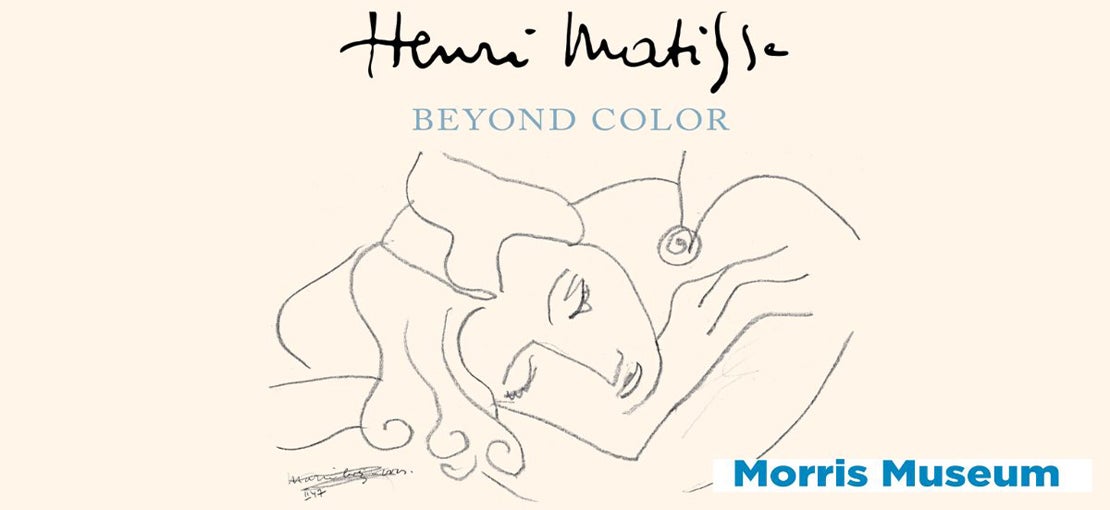
The Morris Museum has organized a new exhibition opening April 12th, Henri Matisse: Beyond Color, featuring an important cache of drawings made by Henri Matisse (French, 1869-1954) generously on loan from the Mourlot Archive. On view will be works Matisse produced together with master lithographer Fernand Mourlot (French, 1895-1988) in creating 13 of the artist books of poetry that defined the final two decades of his career. Key to the project is its consideration of the relationships between the artist and Mourlot, Matisse’s conception of a seamless link that conjoined verse and line drawing, and the intense contexts of Matisse’s own struggles through multiple cataclysms of the 1930s to the time of his death in 1954.
Discover Beautiful Drawings
This exhibition aims to immerse the visitor in a selection of 71 drawings from the 200+ surviving sheets in the Mourlot archive, among them several never-before-exhibited pieces. Beyond Color considers how literary themes — love, beauty, mortality, sensuality — resonate across time and delves into the particularity of Matisse’s perilous situation at the outbreak of World War II: the separation of his wife, the confiscation of his property, his health crisis and subsequent convalescence. Revealed are both a profound dialogue between word and image and one of the most spectacular “second act” career accomplishments by a towering figure of European Modernism. The exhibition’s continues through August 9.
“In poor health, separated from his family, and working through the hardships of war, Matisse pursued with new purpose the foundational strand of artistic excellence— drawing—in ways that redefined his ultimate place within the canon of Modernism,” says Thomas J. Loughman, Morris Museum President and CEO. “The works—faithfully stewarded by Mourlot’s descendants and presented through a most personal lens of art making and creativity amid crisis—are inspiring. This is a project we can all look to amid our own challenges today.”
This period of artistic growth coincided with personal and historical challenges for Henri Matisse, as well as for millions of people in his day and for many today. Facing the realities of fractured family dynamic, declining health, and the lethal and materially destructive turmoil of war (in his case, an additional weaponizing of cultural politics by the Third Reich that deemed his work Degenerate Art and vowed to exterminate his colorist legacy and imprison fellow creatives), he found renewed inspiration and a purpose for his creativity by recasting literary works in deluxe-edition projects. Central to the exhibition is Matisse’s critical engagement with the French literary canon. Drawing on the work of poets such as Pierre de Ronsard (1524–1585), Charles Baudelaire (1821–1867), and Tristan Tzara (1896-1963), Matisse interpreted poetic imagery and transformed language into line.
The Artist in Later Years
Henri Matisse entered a prolific, new chapter of his career around his 70th birthday through his collaborations with leading poets, publishers, and foremost Mourlot. Together, they produced limited-edition artist books (livres peintre) of Matisse’s drawings and poetic works from France’s contemporary and literary canon. Through minimal yet deeply expressive lines, Matisse transformed poetry into visual form, creating works of striking clarity and beauty within portraits, nudes, botanical forms, and mythological imagery. In addition to the drawings, the exhibition includes Matisse’s handwritten corrections of page proofs, and trial impressions, as well as six original lithographic stones, Mourlot’s printing press, and letters between Matisse and Mourlot illuminating the technical and artistic process. Mourlot’s Paris studio became a vital site of experimentation, where artists such as Matisse, Picasso, and Miró were invited to draw directly onto lithographic stones—a process that preserved the immediacy and spontaneity of the artist’s hand.
The exhibition is organized by Thomas J. Loughman, President and CEO of the Morris Museum. The objects in Henri Matisse: Beyond Color are on loan from the Mourlot Archive.
For more information and a digital press kit, please contact mromero@morrismuseum.org
About Mourlot Frères
For over 152 years, Mourlot Frères has been synonymous with the resurgence of lithography – a process which, under their influence, attracted the greatest artistic masters of our time. The medium provided a new avenue of expression, a new realm of possibilities for the likes of Pablo Picasso (1881–1973), Henri Matisse (1869–1954), Marc Chagall (1887–1985), Joan Miró (1893–1983), Georges Braque (1882–1963), Jean Dubuffet (1901–1985), Fernand Léger (1881–1955), and Alberto Giacometti (1901–1966) to enrich their own work as well as fine art in general. Under the guidance of Mourlot, modern lithography developed a personality and discovered a future.



Add A Comment
Thank you for your comment.
Sorry! There was a problem with your comment submission. Please try again.
Comment
Allowed HTML: <b>, <i>, <u>, <a>
Comments
Thank you for your comment.
Sorry! There was a problem with your comment submission. Please try again.
Thank you for your comment.
Sorry! There was a problem with your comment submission. Please try again.